
Social enterprises are increasingly recognized for their unique approach to business, blending profit generation with positive social and environmental impact. This model challenges traditional for-profit structures by prioritizing a dual bottom line: financial sustainability and measurable social good. Understanding the intricacies of a social enterprise business model requires examining its core components, impact measurement strategies, funding mechanisms, and ethical considerations.
This exploration will delve into the diverse approaches and challenges faced by these innovative organizations.
From the innovative structures of B Corps to the community-focused nature of social cooperatives, various models exist, each with unique revenue streams and social impact strategies. This discussion will unpack these variations, exploring how social enterprises navigate the complexities of balancing financial viability with their core mission. We will also analyze the critical role of impact measurement and reporting in attracting investors, building trust, and ensuring accountability.
Defining the Social Enterprise Business Model
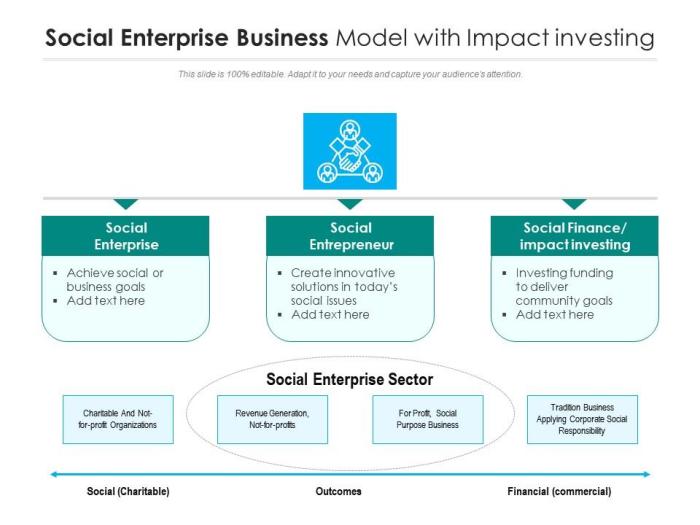
Social enterprises represent a unique blend of business acumen and social mission. Unlike traditional for-profit businesses that prioritize profit maximization above all else, social enterprises integrate a social or environmental mission into their core business model, aiming to generate both profit and positive social impact. This dual focus shapes their operations, strategies, and overall approach to business.Social enterprises achieve profitability through various means, while simultaneously addressing a specific social or environmental issue.
This differs significantly from traditional for-profit businesses, which primarily focus on maximizing shareholder value and often treat social and environmental considerations as secondary concerns, or as mere corporate social responsibility initiatives.
Types of Social Enterprise Business Models
Several models exist within the social enterprise landscape, each with unique characteristics. Understanding these variations provides a clearer picture of the sector’s diversity and adaptability.
| Business Model | Revenue Generation | Social Impact Measurement | Governance Structure |
|---|---|---|---|
| B Corporation (B Corp) | Diverse revenue streams, including product sales, services, and grants. Profit is reinvested to further the social mission. | Uses the B Impact Assessment, a standardized tool measuring environmental and social performance. Reports are publicly available, enhancing transparency and accountability. | Typically operates as a for-profit company, but with a legally binding commitment to social and environmental responsibility. Governance structures often include a board of directors with a mix of stakeholder representation. |
| Social Cooperative | Membership fees, product/service sales, and grants. Profits are often reinvested or distributed among members, prioritizing community benefit. | Impact is measured through community engagement, member satisfaction, and achievement of cooperative goals, often documented through internal reports and community feedback. | Democratic governance structure where members have voting rights and participate in decision-making. Decisions are made collectively, reflecting the cooperative’s principles of equality and democratic participation. |
| Nonprofit with Social Enterprise Activities | Grants, donations, fundraising events, and revenue from commercial activities (e.g., selling products or services related to their mission). | Impact is measured through metrics aligned with their mission, often tracked through program evaluations and beneficiary surveys. Financial reports demonstrate responsible use of funds. | Governed by a board of directors, often with a focus on accountability and transparency to donors and the public. Profits are reinvested to further the nonprofit’s mission, not distributed to shareholders. |
Mission-Driven vs. Profit-Maximizing Approaches
The core distinction lies in the primary objective. Traditional businesses primarily aim to maximize profits for shareholders, while social enterprises strive to balance profit generation with achieving a measurable social or environmental impact. This difference is reflected in their decision-making processes, resource allocation, and overall business strategies. For instance, a traditional clothing company might prioritize lower production costs, even if it means compromising worker safety or environmental sustainability.
In contrast, a social enterprise clothing company would likely prioritize ethical sourcing and sustainable manufacturing practices, even if it means higher production costs and potentially lower profit margins in the short term. The long-term value creation, however, considers both financial and social returns.
Funding and Financial Sustainability
Securing sufficient and sustainable funding is a critical challenge for social enterprises. Their dual mission – generating social impact alongside financial returns – requires a diverse and robust funding strategy. Unlike traditional businesses focused solely on profit, social enterprises often need to navigate a complex landscape of funding sources, each with its own set of advantages and disadvantages.
Social enterprises require a multifaceted approach to financial planning, balancing the need for social impact with the demands of financial viability. This necessitates a clear understanding of various funding options, their associated risks and rewards, and a carefully constructed financial model that projects revenue, manages expenses, and Artikels a realistic funding strategy.
Funding Options for Social Enterprises
Several avenues exist for social enterprises to secure funding. These options vary significantly in their terms, requirements, and impact on the enterprise’s operations and governance.
Understanding the nuances of each funding source is crucial for selecting the most appropriate mix for a specific social enterprise and its mission. The choice will often depend on the stage of the enterprise’s development, its risk profile, and the nature of its social impact.
- Grants: Grants from foundations, government agencies, and corporations are often crucial for early-stage social enterprises. These funds typically come with specific requirements and reporting obligations. While grant funding can be invaluable for launching initiatives, securing grants is highly competitive and requires strong proposals demonstrating clear social impact and financial management.
- Impact Investing: Impact investors seek both financial returns and positive social or environmental impact. They invest in social enterprises through equity investments, debt financing, or other instruments. This funding source provides capital but also requires strong financial projections and a clear articulation of the social impact metrics.
- Social Bonds: Social bonds are debt instruments specifically designed to finance social projects. Investors receive a financial return while contributing to a social cause. This mechanism can attract a wider range of investors and provide long-term funding, but it also requires a robust financial structure and strong creditworthiness.
- Crowdfunding: Crowdfunding platforms allow social enterprises to raise capital from a large number of individuals through online campaigns. This can be an effective way to build community support and raise awareness, but it relies heavily on successful marketing and engagement with potential donors.
Challenges in Securing Funding and Achieving Financial Sustainability
Social enterprises face unique challenges in securing funding and maintaining financial sustainability. The dual bottom line—social impact and financial performance—requires careful balancing and necessitates a more comprehensive approach to financial planning than traditional businesses.
These challenges often stem from the inherent complexities of measuring social impact, the difficulty in attracting investors accustomed to traditional financial metrics, and the need for innovative funding models that accommodate the social mission.
- Measuring Social Impact: Quantifying and demonstrating social impact can be difficult, making it challenging to attract investors and secure grants that often require rigorous impact measurement and reporting.
- Balancing Social Mission and Financial Viability: Maintaining a delicate balance between achieving social impact and generating sufficient revenue to sustain operations is a constant challenge.
- Competition for Funding: The competitive landscape for social enterprise funding is intense, with many organizations vying for limited resources.
- Access to Traditional Financing: Traditional lenders may be hesitant to provide loans to social enterprises due to perceived higher risk and the difficulty in assessing their financial performance based on traditional metrics.
Advantages and Disadvantages of Different Funding Sources
The choice of funding source significantly impacts a social enterprise’s trajectory. Each option presents unique advantages and disadvantages that must be carefully considered.
A balanced funding strategy often involves a mix of sources to mitigate risks and leverage the strengths of each option.
| Funding Source | Advantages | Disadvantages | Example |
|---|---|---|---|
| Grants | Non-dilutive funding, can provide crucial early-stage capital | Highly competitive, often comes with restrictions and reporting requirements | A foundation grant to a community garden project |
| Impact Investing | Access to larger capital sums, alignment with social mission | Can be dilutive, requires strong financial projections and impact measurement | An equity investment in a renewable energy company |
| Social Bonds | Access to a broader investor base, long-term funding | Requires strong creditworthiness and financial transparency | A bond issued to finance affordable housing development |
| Crowdfunding | Builds community support, raises awareness | Relies on successful marketing, can be unpredictable | A Kickstarter campaign for a fair-trade coffee cooperative |
Hypothetical Financial Plan for a Social Enterprise
Let’s consider a hypothetical social enterprise: “GreenGrow,” a company that provides affordable, organic produce to low-income communities while employing individuals from disadvantaged backgrounds.
This financial plan Artikels projected revenue, expenses, and a funding strategy for the first three years of operation.
| Year | Revenue Projections | Expense Budget | Funding Strategy |
|---|---|---|---|
| 1 | $50,000 (sales of produce) | $75,000 (labor, supplies, marketing) | $25,000 grant from a local foundation |
| 2 | $100,000 (increased sales, expanded distribution) | $90,000 (increased labor costs, improved infrastructure) | $10,000 crowdfunding campaign, $10,000 impact investment |
| 3 | $150,000 (further expansion, partnerships with food banks) | $120,000 (increased efficiency, scaling operations) | $30,000 revenue reinvestment, exploration of social bonds |
Ethical Considerations and Governance
Ethical considerations are paramount for the success and longevity of any social enterprise. Operating with integrity not only builds trust with stakeholders but also ensures the mission’s impact is genuinely positive and sustainable. A strong ethical framework guides decision-making, fostering accountability and transparency in all aspects of the organization’s operations. Ignoring ethical considerations can lead to reputational damage, loss of funding, and ultimately, failure to achieve the social mission.
Ethical Dilemmas and Their Resolution
Social enterprises often encounter complex ethical dilemmas that require careful consideration and thoughtful solutions. For example, a fair trade coffee cooperative might face the challenge of balancing the need for fair prices for farmers with the competitive pressures of the market. One approach might involve diversifying product offerings, developing strong relationships with ethical consumers willing to pay a premium, and investing in farmer training and infrastructure to improve efficiency and quality.
Another example could involve a social enterprise focused on providing affordable housing. They might face the ethical dilemma of selecting tenants, balancing the need for fair access with limited resources and the desire to support those most in need. A transparent and equitable application process, alongside partnerships with community organizations, could ensure fair allocation and mitigate bias.
These examples highlight the need for proactive ethical frameworks and decision-making processes that prioritize both social impact and financial viability.
Transparency and Accountability in Building Trust
Transparency and accountability are the cornerstones of building trust with stakeholders, including beneficiaries, investors, employees, and the wider community. Openly communicating the social enterprise’s mission, activities, financial performance, and impact metrics demonstrates commitment to ethical practices. Regularly publishing reports, participating in independent audits, and actively engaging with stakeholders fosters accountability and builds confidence. A social enterprise that embraces transparency creates a culture of trust, attracting support from individuals and organizations who value ethical business practices.
This, in turn, strengthens the organization’s ability to achieve its social mission and ensure its long-term sustainability. Without transparency, skepticism and mistrust can undermine even the most well-intentioned efforts.
Code of Ethics for a Hypothetical Social Enterprise
Our social enterprise, “GreenHarvest,” is committed to ethical conduct and social responsibility in all our operations. We adhere to the following principles:
1. Fairness and Equity
We treat all stakeholders—employees, farmers, customers, and the community—with fairness and respect, ensuring equitable access to opportunities and resources.
2. Transparency and Accountability
We maintain open and honest communication, providing regular updates on our progress and performance. We are committed to independent audits and responsible financial management.
3. Environmental Sustainability
We operate in an environmentally responsible manner, minimizing our ecological footprint and promoting sustainable practices throughout our supply chain.
4. Community Engagement
We actively engage with the communities we serve, seeking their input and working collaboratively to address local needs.
5. Integrity and Honesty
We conduct our business with integrity and honesty, upholding the highest ethical standards in all our dealings.
6. Employee Well-being
We provide a safe, supportive, and inclusive workplace that values employee well-being and promotes professional development.
7. Continuous Improvement
We continuously strive to improve our ethical practices and social impact, adapting our strategies as needed to achieve our mission.
Business Coaching and Mentorship
Business coaching and mentorship play a crucial role in the success and sustainability of social enterprises. These support systems provide social entrepreneurs with the guidance, skills, and networks necessary to navigate the complexities of running a socially impactful business while achieving financial stability. Access to experienced professionals who understand the unique challenges and opportunities of the social enterprise sector is invaluable for growth.Effective business coaching and mentorship programs are vital for helping social enterprises overcome hurdles and maximize their potential for positive social change.
By providing tailored support and fostering strong relationships, these programs empower social entrepreneurs to build resilient and impactful organizations.
Effective Coaching Strategies for Social Entrepreneurs
Effective coaching strategies for social entrepreneurs often involve a blend of practical business advice and guidance on navigating the unique challenges of balancing social mission with financial sustainability. This can include goal setting exercises tailored to both social impact metrics and financial targets, developing robust business plans that clearly articulate the social enterprise’s mission and strategy, and implementing effective marketing and fundraising strategies.
For example, a coach might help a social enterprise refine its value proposition to better resonate with its target audience, or assist in developing a comprehensive financial model that demonstrates long-term viability. Furthermore, coaches can help social entrepreneurs develop strong leadership skills, build effective teams, and cultivate a culture of innovation and continuous improvement.
Benefits of Mentorship Programs for Social Enterprises
Mentorship programs offer invaluable support to social enterprises by connecting them with experienced professionals who can provide guidance, advice, and networking opportunities. Mentors, often successful entrepreneurs or individuals with expertise in relevant fields, share their knowledge and experience, offering a valuable perspective and helping social entrepreneurs avoid common pitfalls. The benefits extend beyond practical business advice; mentorship can also provide emotional support and encouragement, particularly during challenging periods.
A strong mentor-mentee relationship can foster trust and create a safe space for open communication and feedback. For instance, a mentor might help a social entrepreneur navigate complex regulatory issues, secure funding, or develop a strategic partnership.
Key Areas Where Business Coaching Can Benefit Social Enterprises
The value of business coaching for social enterprises is multifaceted. Providing tailored support across various operational aspects is key to success.
- Strategic Planning: Developing a clear vision, mission, and strategic goals aligned with both social impact and financial sustainability.
- Financial Management: Improving financial planning, budgeting, and fundraising strategies to ensure long-term financial stability.
- Marketing and Sales: Enhancing marketing and sales strategies to reach target audiences and increase revenue generation.
- Operations Management: Optimizing operational efficiency, improving processes, and managing resources effectively.
- Team Building and Leadership: Developing strong leadership skills, building high-performing teams, and fostering a positive work environment.
- Social Impact Measurement: Developing robust methods to track and measure social impact, demonstrating accountability and effectiveness.
- Legal and Regulatory Compliance: Navigating legal and regulatory requirements specific to the social enterprise sector.
- Networking and Partnerships: Building strategic partnerships and leveraging networks to expand reach and impact.
Ultimately, the social enterprise business model represents a powerful alternative to traditional business practices. By prioritizing both profit and purpose, these organizations demonstrate the potential for businesses to be forces for positive change. The journey, however, is not without its challenges, requiring careful consideration of funding, ethical considerations, and effective business strategies. Understanding these complexities is crucial for the continued growth and success of the social enterprise sector, paving the way for a more equitable and sustainable future.
Popular Questions
What is the difference between a social enterprise and a non-profit?
While both prioritize social good, non-profits rely primarily on donations and grants, while social enterprises generate revenue through business activities to fund their mission.
How can I measure the social impact of my social enterprise?
Develop clear, measurable goals and KPIs aligned with your mission. Track data regularly and use qualitative and quantitative methods to assess your impact.
What are some common challenges faced by social enterprises?
Securing funding, balancing social impact with profitability, and scaling operations while maintaining ethical practices are common challenges.
Are there specific legal structures for social enterprises?
Yes, depending on your location, various legal structures exist, such as B Corps, Limited Liability Companies (LLCs), and cooperatives, each offering different benefits and requirements.


