In today’s dynamic business landscape, prioritizing profit alone is no longer sufficient. A shift towards value-based business strategies is gaining momentum, recognizing that long-term success hinges on creating and delivering exceptional value to all stakeholders. This comprehensive guide explores the multifaceted aspects of this approach, from defining core principles and identifying key value drivers to aligning operations, communicating effectively, and navigating ethical considerations.
We’ll delve into practical frameworks for measuring intangible value, aligning internal processes with the overarching strategy, and fostering employee engagement to enhance value creation. Furthermore, we will examine how to leverage business development activities, secure appropriate financing, and minimize the environmental impact of business operations, all within a value-driven framework. This exploration aims to equip readers with the knowledge and tools necessary to implement and sustain a thriving value-based business strategy.
Ethical Considerations in Value-Based Strategy
A value-based business strategy, while focused on creating value for stakeholders, must inherently incorporate strong ethical considerations. Ignoring ethical implications can lead to reputational damage, legal repercussions, and ultimately, the erosion of the very value the strategy aims to create. A truly sustainable value-based strategy necessitates a robust ethical framework guiding its development and implementation.
The Importance of Ethical Considerations in Value-Based Strategy Development and Implementation
Ethical considerations are not merely an add-on to a value-based strategy; they are fundamental to its success. Integrating ethics from the outset ensures that value creation is pursued responsibly and sustainably. This includes considering the environmental impact of operations, treating employees fairly, engaging honestly with customers, and acting with integrity in all business dealings. A lack of ethical consideration can lead to short-term gains that are ultimately unsustainable, as evidenced by numerous corporate scandals that have resulted in significant financial losses and reputational damage.
For example, the Volkswagen emissions scandal demonstrated how prioritizing short-term profits over ethical considerations and environmental regulations ultimately resulted in devastating long-term consequences.
Examples of Ethical Dilemmas Related to Value Creation
Ethical dilemmas frequently arise in the pursuit of value creation. One common example involves the tension between maximizing shareholder value and acting responsibly towards employees or the environment. A company might face pressure to cut costs by reducing employee benefits or outsourcing production to countries with lax environmental regulations, even if these actions compromise ethical principles. Another example is the use of data.
While data-driven insights are crucial for value creation, the collection and use of customer data must be done ethically and transparently, respecting privacy and avoiding manipulative practices. The ethical dilemma lies in balancing the benefits of data analysis with the protection of individual privacy rights.
The Role of Corporate Social Responsibility in a Value-Based Approach
Corporate Social Responsibility (CSR) is integral to a value-based strategy. CSR initiatives demonstrate a commitment to ethical conduct beyond legal requirements. These initiatives can include environmental sustainability programs, charitable giving, fair labor practices, and community engagement. By integrating CSR into its core operations, a company demonstrates its commitment to creating value not just for shareholders, but for all stakeholders, including employees, customers, communities, and the environment.
Companies like Patagonia, known for their commitment to environmental sustainability and fair labor practices, exemplify the positive impact of integrating CSR into a value-based strategy. Their success demonstrates that ethical considerations and profitability are not mutually exclusive.
Different Ethical Frameworks for Guiding Business Decisions
Several ethical frameworks can guide business decisions within a value-based strategy. Utilitarianism, for example, focuses on maximizing overall happiness and well-being. Deontology emphasizes adhering to moral duties and principles, regardless of the consequences. Virtue ethics focuses on cultivating moral character and integrity. A company might adopt a hybrid approach, incorporating elements from different frameworks to create a comprehensive ethical guideline.
The choice of framework depends on the specific context and values of the organization. For instance, a company prioritizing employee well-being might favor a utilitarian approach, while one focused on upholding strict principles of fairness might adopt a deontological framework.
A Code of Conduct Reflecting the Ethical Principles of the Value-Based Strategy
A comprehensive code of conduct is essential for operationalizing ethical principles within a value-based strategy. This code should clearly articulate the company’s commitment to ethical behavior and provide specific guidelines for employees in various situations. It should address issues such as conflicts of interest, data privacy, environmental responsibility, fair labor practices, and anti-corruption measures. The code should be readily accessible to all employees, regularly reviewed and updated, and enforced consistently.
Furthermore, mechanisms for reporting ethical violations and protecting whistleblowers should be established to foster a culture of ethical accountability. For example, the code might state: “We are committed to conducting our business with the highest ethical standards, respecting the rights and dignity of all individuals, protecting the environment, and acting with integrity in all our dealings.” This commitment would be further detailed with specific rules and guidelines for each area mentioned.
Business Coaching and Value-Based Strategy
Implementing a value-based strategy requires more than just a well-crafted plan; it demands a cultural shift within an organization. Business coaching plays a crucial role in facilitating this transformation, guiding leaders and teams to internalize and embody the organization’s values, ultimately driving sustainable success. This section explores the vital contribution of business coaching in the successful implementation of a value-based strategy.
The Role of Business Coaching in Value-Based Strategy Implementation
Business coaching provides the personalized support and guidance necessary to navigate the complexities of shifting towards a value-based approach. Coaches act as catalysts, helping leaders identify and overcome obstacles, develop new skills, and build the necessary resilience to maintain momentum throughout the transformation. They challenge limiting beliefs, foster self-awareness, and empower leaders to make conscious decisions aligned with the organization’s values.
This tailored approach ensures that the value-based strategy is not merely adopted, but genuinely integrated into the organization’s DNA.
Examples of Coaching in Embedding Value-Based Thinking
A coach might work with a CEO struggling to articulate the company’s values in a meaningful way, guiding them through exercises to clarify their personal values and connect them to the organizational goals. In another scenario, a coach could facilitate workshops for a leadership team to identify and address inconsistencies between espoused values and actual behavior. For example, a company promoting sustainability might be found to be using unsustainable practices in its supply chain.
The coach helps the team understand the dissonance and develop action plans to align their actions with their stated values. Finally, coaching can help leaders develop effective communication strategies to articulate the value proposition to employees, customers, and stakeholders, building trust and buy-in.
Key Skills and Qualities of a Coach Supporting Value-Based Transformation
Effective coaching in this context requires a unique blend of skills. Coaches must possess strong active listening skills to understand the leader’s challenges and perspectives. They need to be adept at asking powerful questions that encourage self-reflection and promote insight. Furthermore, they should be skilled in facilitating difficult conversations, helping leaders navigate conflict and resistance to change.
Crucially, they must demonstrate empathy and create a safe space for vulnerability and honest self-assessment. Impartiality and ethical conduct are paramount, ensuring that coaching remains aligned with the organization’s values and the leader’s best interests.
Comparison of Coaching Methodologies for Driving Value-Based Change
Several coaching methodologies can be effective in driving value-based change. Solution-focused coaching, for instance, emphasizes identifying strengths and resources to overcome challenges, fostering a positive and proactive approach to implementation. Transformational coaching, on the other hand, focuses on deeper self-awareness and personal growth, enabling leaders to embody the values they wish to instill in their organization. Cognitive behavioral coaching helps leaders identify and modify unhelpful thought patterns that might hinder the adoption of a value-based approach.
The choice of methodology depends on the specific needs and context of the leader and organization.
A Coaching Plan for a Leader Implementing a Value-Based Strategy
A typical coaching plan might involve initial assessments to understand the leader’s current understanding of the value-based strategy and their perceived challenges. This would be followed by the establishment of clear, measurable goals aligned with the organizational objectives. Regular coaching sessions would then focus on developing specific skills, such as effective communication, conflict resolution, and decision-making aligned with the values.
Action planning between sessions would ensure progress and accountability. The plan would also incorporate regular review sessions to assess progress, adjust strategies as needed, and celebrate achievements along the way. The entire process should be iterative and adaptable to the evolving needs of the leader and the organization.
Financing and Value-Based Strategy (Business Loans & Business Model)
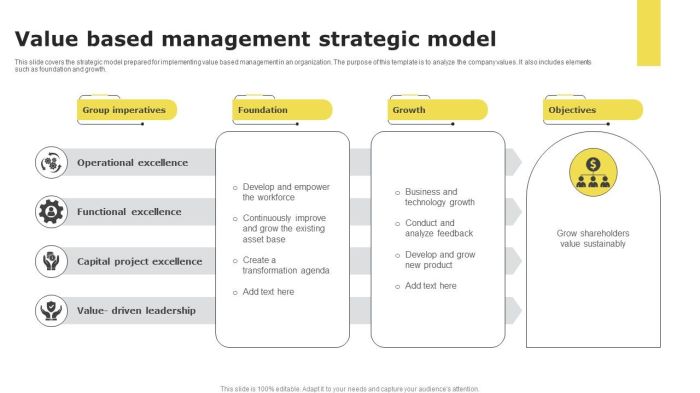
A value-based business strategy, focused on delivering exceptional customer value and building strong relationships, often requires significant investment. Securing appropriate financing is crucial for successful implementation, and the chosen business model significantly influences funding needs and strategies. Understanding the interplay between financing options and a value-based approach is key to sustainable growth.
Business loans play a vital role in supporting the implementation of a value-based strategy. They provide the capital necessary to invest in areas that directly enhance customer value, such as improved product quality, enhanced customer service, or the development of innovative solutions. This investment, in turn, strengthens the company’s brand reputation, fosters customer loyalty, and ultimately drives long-term profitability.
Access to capital allows for strategic initiatives that might otherwise be delayed or impossible, accelerating the realization of the value-based vision.
Business Models Reflecting a Value-Based Approach
Different business models inherently reflect varying degrees of emphasis on value creation. For example, a subscription-based model, where customers pay recurring fees for ongoing access to a product or service, incentivizes businesses to focus on customer retention and satisfaction. This model prioritizes long-term relationships over short-term profits, a core tenet of value-based strategy. Conversely, a freemium model, offering a basic service for free and charging for premium features, requires a strong understanding of customer needs and a strategic approach to upselling and cross-selling, again highlighting the importance of customer value.
A social enterprise, which explicitly aims to solve social or environmental problems alongside generating profit, demonstrates a direct alignment between business objectives and societal value creation.
Relationship Between Value Proposition and Funding Needs
A company’s value proposition – its unique offering that provides value to customers – directly influences its funding needs. A value proposition focused on premium quality and exceptional customer service will likely require higher initial investment in production, training, and technology compared to a value proposition emphasizing low cost and efficiency. For instance, a luxury goods company aiming to build a brand around exquisite craftsmanship and personalized service will need more capital for skilled artisans and bespoke customer experiences than a company selling mass-produced, low-cost items.
The more complex and value-added the proposition, the greater the initial capital outlay and, potentially, the longer the time horizon before profitability is realized.
Financing Options for Value-Based Businesses
Several financing options cater to the specific needs of businesses pursuing a value-based strategy. Traditional bank loans provide a relatively stable source of funding, but may require significant collateral and a robust business plan demonstrating long-term profitability. Venture capital and angel investors are often attracted to businesses with high growth potential and a strong value proposition, providing equity financing in exchange for a share of ownership.
Crowdfunding platforms allow businesses to directly engage with potential customers and raise capital through pre-orders or donations, building community and brand loyalty simultaneously. Government grants and subsidies, particularly for businesses focused on social or environmental impact, offer non-dilutive funding opportunities. The choice of financing depends on factors such as the company’s stage of development, risk tolerance, and the nature of its value proposition.
Financial Model Demonstrating Long-Term Value Creation
A simplified financial model could demonstrate the long-term value creation potential of a value-based approach. Let’s consider a hypothetical company that invests in improving customer service, leading to increased customer retention and higher lifetime value. Assume an initial investment of $100,000 in customer service training and technology. This investment results in a 10% increase in customer retention from 70% to 80%, and a 5% increase in average customer lifetime value from $1,000 to $1,050.
With an annual customer acquisition cost of $100 and 1000 acquired customers per year, the increased retention and lifetime value generate additional revenue over a 5-year period. This additional revenue, when discounted to present value, can easily surpass the initial investment, demonstrating the long-term financial return on investment in a value-based approach. A detailed model would include projected revenue growth, cost savings from reduced customer churn, and a discounted cash flow analysis to assess the overall financial viability of the strategy.
This illustrates that while there may be upfront investment, the long-term returns generated by improved customer relationships can far outweigh the initial costs.
Business Strategy and Travel
Business travel, while often a necessary component of many business operations, presents a unique challenge when implementing a value-based strategy. Balancing the need for in-person interactions with the environmental and financial costs associated with travel requires careful planning and a commitment to sustainable practices. A well-defined approach to business travel can significantly contribute to a company’s overall value proposition, both internally and externally.
Impact of Business Travel on Value-Based Strategy Implementation
Business travel can directly impact a value-based strategy’s success. Frequent flights and lengthy trips contribute to a company’s carbon footprint, potentially contradicting values related to environmental sustainability. Furthermore, excessive travel expenses can strain resources, hindering investments in other value-creating activities such as research and development, employee training, or community engagement. Conversely, strategically planned travel can foster stronger client relationships, facilitate knowledge sharing, and drive innovation, aligning with a value-based approach focused on growth and collaboration.
The key lies in optimizing travel to maximize its positive impact while minimizing its negative consequences.
Minimizing the Environmental Impact of Business Travel
Reducing the environmental impact of business travel requires a multifaceted approach. Companies can encourage the use of video conferencing and other virtual communication tools for meetings that don’t require in-person attendance. When travel is unavoidable, opting for more fuel-efficient modes of transportation, such as high-speed rail where feasible, can significantly reduce carbon emissions. Choosing accommodations with strong sustainability certifications and minimizing single-use plastics during trips also contributes to a reduced environmental footprint.
Carbon offsetting programs can be considered to compensate for unavoidable emissions, although these should be carefully vetted for their effectiveness and transparency. For example, a company could partner with a reputable organization that invests in reforestation projects to offset the carbon footprint of its business trips.
Optimizing Business Travel Expenses
Optimizing business travel expenses without compromising effectiveness involves careful planning and negotiation. This includes leveraging technology to find the most cost-effective travel options, negotiating favorable rates with airlines and hotels, and implementing clear travel expense policies that encourage employees to make cost-conscious choices. For instance, a company could establish a tiered travel policy, allowing employees to choose between economy and business class based on the trip’s duration and importance.
Regularly reviewing and updating travel policies and procedures ensures that they remain relevant and efficient. Negotiating group rates for larger teams travelling to the same location can also significantly reduce costs.
Approaches to Managing Business Travel within a Value-Based Framework
Several approaches exist for managing business travel within a value-based framework. A “needs-based” approach prioritizes only essential travel, maximizing the value derived from each trip. A “hybrid” approach combines virtual communication with carefully selected in-person meetings, striking a balance between cost-effectiveness and the benefits of face-to-face interaction. A “sustainability-focused” approach prioritizes environmentally friendly travel options, even if it means slightly higher costs.
The best approach depends on the specific values and priorities of the organization and the nature of its business. For example, a consulting firm might prioritize a needs-based approach to minimize travel costs and maximize profitability, while a non-profit focused on environmental conservation might adopt a sustainability-focused approach.
Sustainable Business Travel Policy
A sustainable business travel policy should integrate environmental, social, and economic considerations. It should Artikel clear guidelines for choosing transportation, accommodation, and other travel-related services, prioritizing sustainability and cost-effectiveness. The policy should also encourage employees to adopt responsible travel behaviors, such as reducing waste and respecting local cultures. Regular review and updates to the policy ensure its ongoing relevance and effectiveness.
The policy could include specific targets for reducing carbon emissions, along with mechanisms for monitoring progress and accountability. For instance, a company might set a goal to reduce its business travel carbon footprint by 10% within the next year, tracking progress monthly and adjusting its policy as needed.
Implementing a value-based business strategy requires a holistic and committed approach. From clearly defining your value proposition and meticulously measuring its impact to fostering a culture of ethical decision-making and aligning all business operations accordingly, the journey demands consistent effort and adaptation. However, the rewards – enhanced stakeholder relationships, improved financial performance, and a lasting positive impact – are substantial and well worth the investment.
This guide serves as a roadmap, offering insights and practical guidance to navigate this transformative journey towards sustainable and impactful business growth.
FAQ Section
What are some common pitfalls to avoid when implementing a value-based strategy?
Common pitfalls include failing to clearly define value, neglecting to measure value effectively, lacking alignment between strategy and operations, and insufficient communication with stakeholders. Ignoring ethical considerations and underestimating the importance of employee engagement can also hinder success.
How can a small business implement a value-based strategy with limited resources?
Small businesses can start by focusing on a niche market where they can deliver exceptional value. Prioritize clear communication, build strong customer relationships, and leverage cost-effective marketing strategies. Focus on measuring key value drivers that are easily quantifiable and align internal processes to support the chosen value proposition.
How can a value-based strategy be adapted to different industries?
The core principles of a value-based strategy remain consistent across industries. However, the specific value drivers and methods for measuring value will vary. For example, a technology company might focus on innovation and user experience, while a healthcare provider might prioritize patient outcomes and quality of care. Adapting the strategy involves identifying the specific values most relevant to the target market and industry context.