
The Business Model Canvas, a powerful tool for visualizing and strategizing business ventures, offers a concise yet comprehensive framework for understanding and refining your business approach. From startups to established corporations, its adaptable nature allows for clear articulation of key elements, fostering effective communication and strategic planning across various industries and organizational structures.
This guide delves into the intricacies of the Business Model Canvas, exploring its core components, practical applications across diverse business scenarios (B2B, B2C, non-profits), and its integration with broader business strategies. We’ll examine its use in competitive analysis, market opportunity identification, and even new product development, highlighting the visual aspects that enhance its effectiveness and ease of understanding.
Applying the Business Model Canvas to Different Business Scenarios
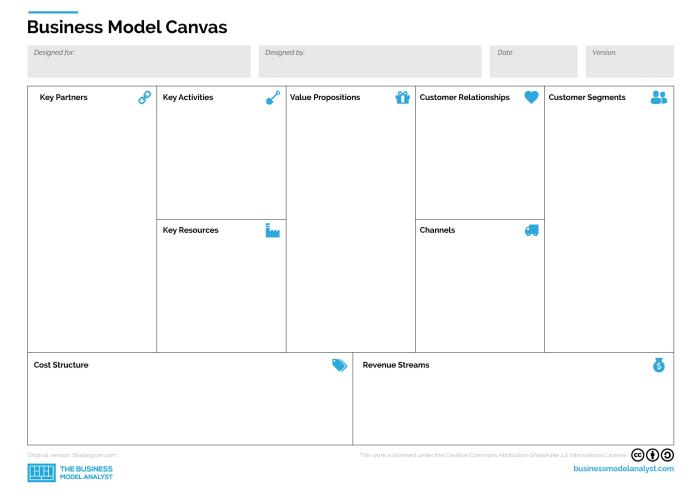
The Business Model Canvas, a strategic management and lean startup template, proves remarkably adaptable across diverse business contexts. Its flexibility allows for insightful analysis and strategic planning regardless of whether a business operates in a B2B, B2C, or non-profit environment. Understanding these applications allows for a more nuanced and effective use of the tool.
Business Model Canvas in B2B vs. B2C Contexts
The core components of the Business Model Canvas remain consistent, but their emphasis shifts depending on whether the target market is businesses (B2B) or consumers (B2C). In B2B scenarios, the “Customer Relationships” segment often focuses on building strong, long-term partnerships, potentially involving key account management and dedicated customer service teams. Pricing strategies might be more complex, involving negotiations and customized contracts.
Conversely, B2C businesses often prioritize reaching a broader audience through marketing and distribution channels focused on mass appeal. Pricing is usually more straightforward and standardized. For example, a B2B software company might focus on relationship building with enterprise clients and offering bespoke solutions, while a B2C e-commerce platform might prioritize user experience and efficient order fulfillment to attract a large customer base.
Using the Business Model Canvas for Strategic Planning
The Business Model Canvas is a powerful tool for strategic planning, enabling businesses to systematically analyze their current position and chart a course for future growth. By completing each building block, businesses gain a holistic view of their operations, identifying potential strengths, weaknesses, opportunities, and threats. This allows for data-driven decision-making, facilitating the development of effective strategies to enhance competitiveness and achieve business objectives.
For instance, a company could use the canvas to identify areas for cost reduction, explore new market segments, or develop innovative products or services. A thorough analysis can pinpoint areas requiring improvement or highlight potential disruptions before they impact the business significantly.
Adapting the Business Model Canvas for Non-Profit Organizations
While profit generation isn’t the primary goal for non-profits, the Business Model Canvas remains highly relevant. Instead of “Revenue Streams,” the focus shifts to “Resource Acquisition,” encompassing donations, grants, and fundraising activities. “Customer Segments” become “Beneficiaries,” and “Value Propositions” describe the social impact the organization delivers. For example, a charity focusing on environmental conservation might detail its fundraising strategies, the communities it serves, and the environmental impact of its projects within the canvas.
This structured approach helps non-profits to articulate their mission effectively, secure funding, and measure their social impact more efficiently.
Using the Business Model Canvas for Innovation and New Product Development
The Business Model Canvas facilitates innovation by encouraging a holistic approach to new product development. By defining the target customer, their needs, and the value proposition, businesses can develop products and services that directly address market demands. It also allows for the exploration of various revenue models and the identification of potential challenges early in the development process.
For instance, a startup developing a new mobile app can use the canvas to define its target audience, determine the app’s key features, Artikel its monetization strategy, and identify potential competitors. This approach helps minimize risk and maximizes the chances of a successful product launch.
Step-by-Step Guide to Filling Out a Business Model Canvas
The process of completing a Business Model Canvas involves a structured approach focusing on each of its nine building blocks.
- Define your Customer Segments: Identify your target audience(s) and their characteristics.
- Craft your Value Propositions: Describe the unique value you offer to each customer segment.
- Artikel your Channels: Determine how you will reach your customers.
- Define your Customer Relationships: Specify the type of relationship you will build with your customers.
- Identify your Revenue Streams: Detail how you will generate revenue.
- List your Key Activities: Artikel the most important activities required to deliver your value proposition.
- Identify your Key Resources: Specify the key assets required to operate your business.
- Determine your Key Partnerships: Identify any strategic partnerships needed.
- Analyze your Cost Structure: Artikel all the costs associated with your business model.
Iterative refinement is key; the canvas should be revisited and updated regularly to reflect changes in the market and business environment. This iterative process allows for continuous improvement and adaptation.
Business Model Canvas and Related Business Concepts
The Business Model Canvas is a powerful tool, far exceeding its role as a simple visual representation of a business. It acts as a dynamic framework that informs and shapes various aspects of a business, from its initial conception to its ongoing development and adaptation. Understanding its interconnectedness with other crucial business concepts is key to leveraging its full potential.
Business Model Canvas and Business Development Strategies
The Business Model Canvas directly informs and shapes business development strategies. By clearly outlining key aspects such as value propositions, customer segments, and revenue streams, the canvas provides a roadmap for growth. For instance, identifying a niche customer segment through the canvas can lead to targeted marketing campaigns and product development focused on meeting their specific needs. Similarly, analyzing revenue streams can highlight opportunities for diversification or expansion into new markets.
A well-constructed canvas facilitates strategic decision-making by providing a clear, concise view of the business and its potential. Continuous review and adaptation of the canvas based on market feedback and performance data ensures the business development strategy remains aligned with market realities.
Ethical Considerations in Business Model Development and Implementation
Developing and implementing a business model requires careful consideration of ethical implications. The canvas itself highlights areas where ethical dilemmas might arise. For example, the “Customer Segments” section necessitates considering the fairness and transparency of target marketing practices. The “Key Activities” section necessitates evaluating the environmental and social impact of business operations. Ethical sourcing, fair labor practices, and data privacy are all crucial considerations that must be integrated into the business model from its inception.
Ignoring these aspects can lead to reputational damage, legal repercussions, and ultimately, business failure. A strong ethical foundation, embedded within the business model canvas, ensures long-term sustainability and builds trust with stakeholders.
Business Coaching and Effective Business Model Canvas Utilization
Business coaching plays a vital role in helping entrepreneurs and businesses effectively utilize the Business Model Canvas. A coach can guide individuals through a structured process of completing the canvas, prompting critical self-reflection and challenging assumptions. They can facilitate discussions around potential blind spots, encourage innovative thinking, and provide valuable external perspectives. Moreover, coaches can assist in translating the canvas into actionable strategies, ensuring that the information isn’t simply a static document but a living tool that guides decision-making and drives progress.
Their expertise helps businesses to maximize the canvas’s potential for strategic planning and operational efficiency.
Securing Business Loans Based on a Strong Business Model Canvas
A robust Business Model Canvas significantly increases the likelihood of securing business loans. Lenders often require detailed business plans, and the canvas provides a clear and concise summary of the business’s key elements. The canvas’s visual nature allows lenders to quickly grasp the business’s core value proposition, target market, and financial projections. A well-defined revenue model, clearly articulated within the canvas, demonstrates the business’s potential for profitability and repayment capacity.
Furthermore, the canvas’s structure facilitates a thorough analysis of risks and mitigations, providing lenders with reassurance and confidence in the business’s viability. Therefore, a strong canvas serves as compelling evidence of the business’s potential for success, making it a valuable asset in the loan application process. For example, a startup with a clearly defined customer segment, a proven value proposition, and a realistic financial projection, as evidenced by their business model canvas, is far more likely to receive funding than one lacking this clarity.
Connection Between a Well-Defined Business Model and Overall Business Strategy
A well-defined business model is intrinsically linked to the overall business strategy. The canvas acts as a foundational element, providing the blueprint for achieving strategic goals. A clear articulation of the value proposition, customer segments, and revenue streams directly influences strategic decisions related to marketing, operations, and finance. For instance, a business strategy focused on rapid growth would require a business model that supports scalability and efficient resource allocation.
Conversely, a strategy focused on sustainability might necessitate a business model that prioritizes ethical sourcing and environmental responsibility. The business model canvas ensures alignment between the various components of the business strategy, promoting consistency and efficiency in achieving overall objectives. Without a well-defined business model, the business strategy risks becoming a set of disconnected goals, lacking the concrete mechanisms for implementation and success.
Visualizing the Business Model Canvas
The Business Model Canvas, while powerful in its conceptual framework, truly shines when visualized. A well-designed visual representation transforms a potentially abstract set of concepts into a clear, easily digestible, and engaging overview of a business’s strategy. This allows for quicker understanding, improved collaboration, and more effective communication among stakeholders.A strong visual representation leverages the inherent relationships between the nine building blocks of the Business Model Canvas to create a cohesive and informative whole.
The visual design itself should enhance, not detract from, the understanding of the business model.
Effective Visual Representations of Business Model Canvases
Effective visual representations prioritize clarity and conciseness. Instead of simply listing the nine building blocks in a linear fashion, a successful visual representation emphasizes the interconnectedness of these components. For example, arrows might link “Customer Segments” to “Value Propositions,” illustrating the direct relationship between the target market and the offered value. Color-coding can further enhance understanding by grouping related elements, such as those related to the customer or the financial aspects of the business.
In presentations, a well-designed BMC can serve as a central visual anchor, allowing the presenter to guide the audience through the key aspects of the business model in a logical and engaging manner. One example could be a BMC displayed on a large screen, with the presenter using a laser pointer to highlight key relationships and discuss specific elements.
Another effective approach might involve using an interactive digital version of the BMC, allowing for dynamic exploration and deeper dives into individual components.
Detailed Description of a Business Model Canvas Illustration
Imagine a Business Model Canvas displayed as a large, landscape-oriented rectangle. Each of the nine building blocks is represented within a clearly defined box, arranged in a logical layout, usually following the standard BMC template. The boxes themselves are filled with concise, bullet-pointed text, avoiding lengthy descriptions. Each box is color-coded, perhaps using a palette of muted tones to maintain professionalism while still allowing for visual distinction between the different components.
For example, “Customer Segments” might be a light blue, “Value Propositions” a light green, and “Revenue Streams” a light orange. The visual connections between the boxes are represented by clearly labeled arrows, indicating the flow of information and relationships. The overall effect is one of visual clarity and information density, where a substantial amount of information is presented in an easily digestible format.
The use of whitespace ensures the image is not cluttered, enhancing readability and preventing visual fatigue.
Visual Elements Enhancing Understanding and Communication
Visual elements significantly improve the understanding and communication of the Business Model Canvas. The use of color-coding, as mentioned, allows for quick identification of related elements and enhances the overall visual appeal. The use of arrows and connectors clearly demonstrates the relationships between the different building blocks, revealing the intricate workings of the business model. Icons or simple graphics can be used to represent complex concepts, making the information more accessible to a wider audience.
A well-designed visual representation also reduces the reliance on lengthy text, allowing for quicker comprehension and facilitating discussions. The visual nature of the canvas makes it a much more engaging and memorable tool than a simple text-based description.
Key Elements of a Business Model Canvas Illustration
- Customer Segments: A description of the target audience, possibly segmented into different groups based on demographics, needs, or behaviors. This section is often visually represented by icons or simple images representing the different customer groups.
- Value Propositions: A concise statement of the value offered to each customer segment. This might be visually represented by icons representing the key benefits or features.
- Channels: The ways in which the company reaches its customer segments. This could be visually represented by icons for different communication methods (e.g., website, social media, retail stores).
- Customer Relationships: The type of relationship the company establishes with its customers. This might be represented visually through icons depicting different relationship types (e.g., personal assistance, self-service).
- Revenue Streams: How the company generates revenue. Visual representation could involve icons representing different revenue models (e.g., subscription fees, advertising).
- Key Activities: The most important things the company does to deliver its value proposition. This might be visually represented by icons or short phrases representing key activities.
- Key Resources: The most important assets the company needs to make its business model work. Visual representations could include icons representing tangible and intangible assets.
- Key Partnerships: The network of suppliers and partners that support the company. This could be visually represented by icons or diagrams illustrating the partnerships.
- Cost Structure: The most important costs incurred in operating the business. Visual representations could be simple charts or icons representing different cost categories.
Business Model Canvas and Practical Applications
The Business Model Canvas, while a powerful tool for developing new ventures, also offers significant utility in analyzing existing businesses, identifying opportunities, and assessing feasibility. Its versatility extends beyond startups, proving invaluable in various business contexts, including strategic planning and operational efficiency. This section explores practical applications of the Business Model Canvas across diverse business scenarios.
Analyzing a Competitor’s Business Model
The Business Model Canvas provides a structured framework for dissecting a competitor’s strategy. By systematically filling out the canvas based on publicly available information (annual reports, websites, news articles, etc.), a detailed understanding of their value propositions, customer segments, revenue streams, and cost structures can be achieved. This comparative analysis highlights strengths and weaknesses, revealing potential areas for competitive advantage or strategic partnerships.
For example, analyzing a competitor’s customer relationships might uncover underserved segments that your business could target. Examining their channels might identify inefficiencies that could be exploited. A thorough analysis can inform strategic decision-making, leading to more effective competitive strategies.
Identifying Potential Market Opportunities
The Business Model Canvas facilitates the identification of untapped market opportunities by prompting a systematic exploration of customer needs and unmet demands. By focusing on specific customer segments and their pain points, businesses can develop innovative value propositions that address these needs. For instance, examining the “Customer Relationships” section might reveal a lack of personalized service in a particular segment, presenting an opportunity to create a highly personalized offering.
Similarly, analyzing the “Channels” section can illuminate gaps in distribution or communication, highlighting opportunities to reach new customers through novel channels. The canvas encourages creative thinking by forcing a structured consideration of all aspects of the business model, leading to the discovery of new possibilities.
Assessing the Feasibility of a New Business Venture
Before investing significant resources in a new venture, a thorough feasibility assessment is crucial. The Business Model Canvas aids in this process by requiring a detailed examination of all key aspects of the proposed business. By systematically filling out the canvas, potential challenges and risks are identified early on. For example, analyzing the “Revenue Streams” section helps determine the viability of the proposed pricing model and the potential for profitability.
Similarly, evaluating the “Key Resources” and “Key Activities” sections helps assess the resources and capabilities needed to execute the business plan. This structured approach helps to identify potential roadblocks and allows for adjustments to the business model before significant investments are made, thus minimizing risk.
Business Travel Planning and Expense Management
While not a traditional application, the Business Model Canvas can be adapted for business travel planning and expense management. Consider “Customer Segments” as the travelers, “Value Propositions” as the travel experience, “Channels” as booking platforms, “Customer Relationships” as the level of support, “Revenue Streams” as the cost of the trip, “Key Activities” as the planning and booking process, “Key Resources” as travel documents and reservations, “Key Partnerships” as airline alliances or travel agencies, “Cost Structure” as the total expenses, and “Revenue Streams” as reimbursements or cost savings.
This structured approach can help streamline the process and improve cost control. For example, identifying key partnerships can lead to cost savings on flights or accommodation.
Case Study: Successful Implementation of a Business Model Canvas – [Fictional Example] “GreenThumb Gardening”
GreenThumb Gardening, a small startup specializing in organic gardening supplies, utilized the Business Model Canvas to refine its business model. Initially, they focused on a broad customer base with a limited product range. After completing the canvas, they identified a niche market: urban dwellers with limited space. This led to a shift in their value proposition, focusing on compact, high-yield gardening solutions.
They adjusted their channels to include online sales and partnerships with local urban farms. The revised business model, based on the Business Model Canvas analysis, resulted in a 30% increase in sales within six months, demonstrating the effectiveness of this tool in driving business growth. The key was not just identifying a niche, but also systematically thinking through all aspects of their business, from customer segments to cost structure, and adapting accordingly.
Ultimately, mastering the Business Model Canvas empowers businesses to articulate their value proposition, identify potential pitfalls, and navigate the complexities of the market landscape with increased clarity and confidence. By utilizing this tool effectively, organizations can streamline their operations, refine their strategies, and ultimately achieve sustainable growth and success. Its versatility and adaptability ensure its continued relevance in the ever-evolving business world.
Questions and Answers
What software can I use to create a Business Model Canvas?
Numerous software options exist, including dedicated Business Model Canvas software, general-purpose diagramming tools (like Lucidchart or Miro), or even simple spreadsheet programs.
How often should I review and update my Business Model Canvas?
Regular review is crucial. Ideally, revisit and update your canvas at least quarterly, or more frequently if significant changes occur in your market, business operations, or strategic direction.
Can I use the Business Model Canvas for a personal project?
Absolutely! While often used for businesses, the framework is adaptable to personal projects, helping you define goals, resources, and potential challenges.
Is there a “right” way to fill out a Business Model Canvas?
There’s no single “right” way. The framework’s value lies in its adaptability. The key is to use it to clearly articulate your business model and identify areas for improvement.


